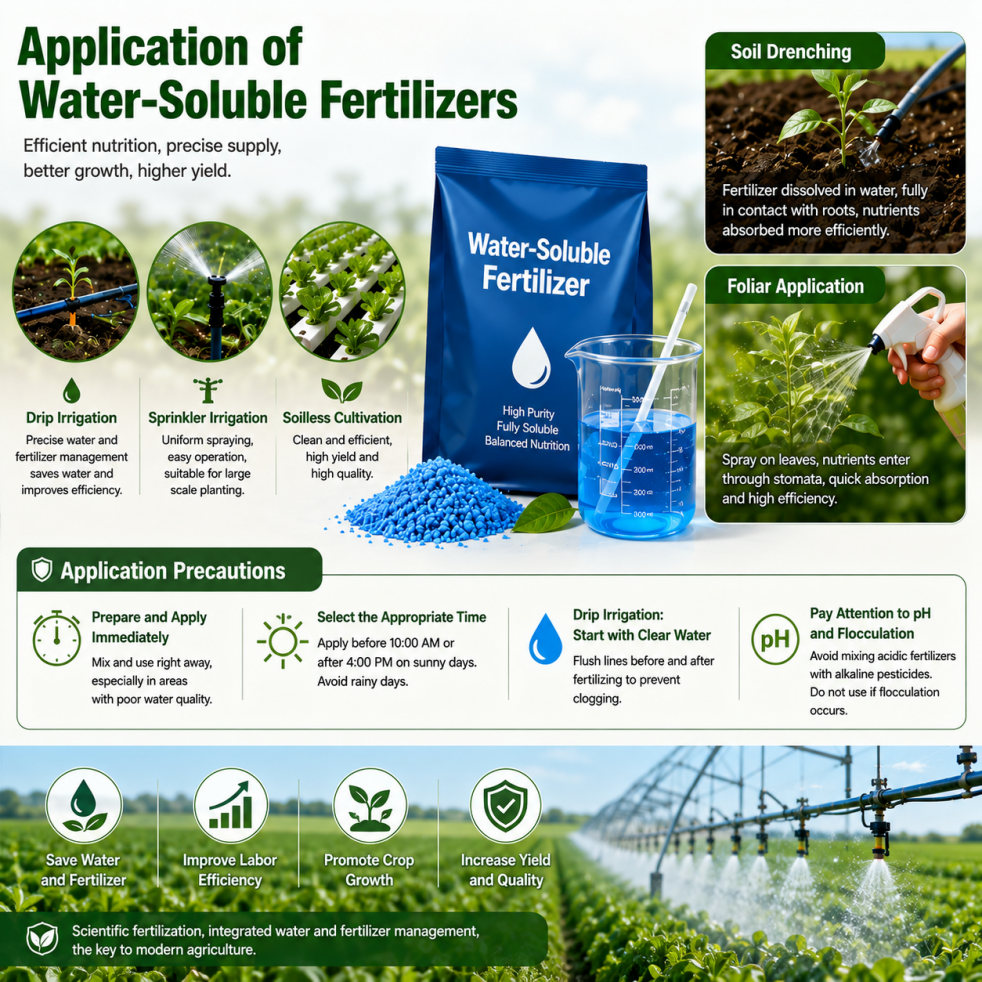
Water-soluble fertilizers are not only diverse in variety but also offer flexible application methods, generally falling into three main categories:
**Drip Irrigation, Sprinkler Irrigation, and Soilless Cultivation**
In regions facing severe water shortages, on large-scale commercial farms, and for high-quality, high-value cash crops, techniques such as drip irrigation, sprinkler irrigation, and soilless cultivation are frequently employed to conserve irrigation water and boost labor productivity. During the irrigation process, the fertilizer is dissolved directly into the water; thus, watering and fertilizing occur simultaneously—a practice known as "integrated water and fertilizer management." This allows plants to obtain their necessary nutrients through the water-soluble fertilizers, thereby conserving water and fertilizer while simultaneously enhancing labor efficiency
**Soil Drenching**
When watering or irrigating the soil, the water-soluble fertilizer is pre-mixed into the irrigation water. This ensures that the plant roots come into full contact with the fertilizer, allowing the chemical nutrient elements to be transported throughout the various plant tissues via root respiration.
**Foliar Application**
Water-soluble fertilizers can be diluted and dissolved in water for direct foliar spraying, or mixed with non-alkaline pesticides for combined application. The nutrients enter the plant's interior through the stomata on the leaves. This method serves as an optimal corrective measure for nutrient deficiencies, particularly in young plants or crops with underdeveloped root systems. It significantly boosts the efficiency of fertilizer absorption and utilization, while also streamlining the internal transport of nutrient elements within the plant.
**Precautions for Applying Water-Soluble Fertilizers**
Applying fertilizer in "small doses, frequently" is a fundamental principle for the rational use of water-soluble fertilizers. This approach aligns with the natural characteristic of plant root systems to absorb nutrients continuously; it also minimizes nutrient loss through leaching—a common issue associated with applying large quantities of fertilizer at one time. When using water-soluble fertilizers, the following precautions should also be observed:
**Prepare and Apply Immediately**
Fertilizers should always be prepared and applied immediately after mixing—especially in areas with poor water quality—to prevent the fertilizer components from reacting adversely with substances present in the water.
**Select the Appropriate Application Time**
On sunny days with high temperatures, fertilizer application should be scheduled for before 10:00 AM or after 4:00 PM to avoid applying the fertilizer under intense direct sunlight. Furthermore, avoid applying fertilizer on rainy days—particularly for foliar spraying—to prevent the fertilizer from being washed away.
**When Using Drip Irrigation, Start with Clear Water**
When applying water-soluble fertilizers via drip irrigation, begin by running clear water through the system first. Start introducing the fertilizer solution only after the irrigation pipelines have been fully filled with water. Immediately after fertilization is complete, run clear water through the system via drip irrigation for 20 to 30 minutes to completely flush out any residual fertilizer solution remaining in the pipelines. Failure to flush the lines may lead to the growth of moss, algae, or other microorganisms at the drip emitters, resulting in clogging.
**Precautions for Mixing: Pay Attention to pH Levels and Flocculation**
When mixing fertilizers with pesticides for root drenching or foliar spraying, avoid combining acidic fertilizers with alkaline pesticides, or alkaline fertilizers with acidic pesticides. Furthermore, it is critical to observe the mixture closely during preparation to check for any signs of flocculation (clumping or precipitation); if flocculation occurs, the mixture must not be used.
 EN
EN